
The Government Quietly Released Its Bigfoot Files. Here's What's in Them.
The U.S. Forest Service posted three 'Bigfoot/Sasquatch Records' files with no announcement. Inside: giant footprints that stumped a federal biologist, a hunter who says 'we have pictures,' and a hoax accusation.

By Nate Jurewicz · Founder & Chief Editor
· 5 min read
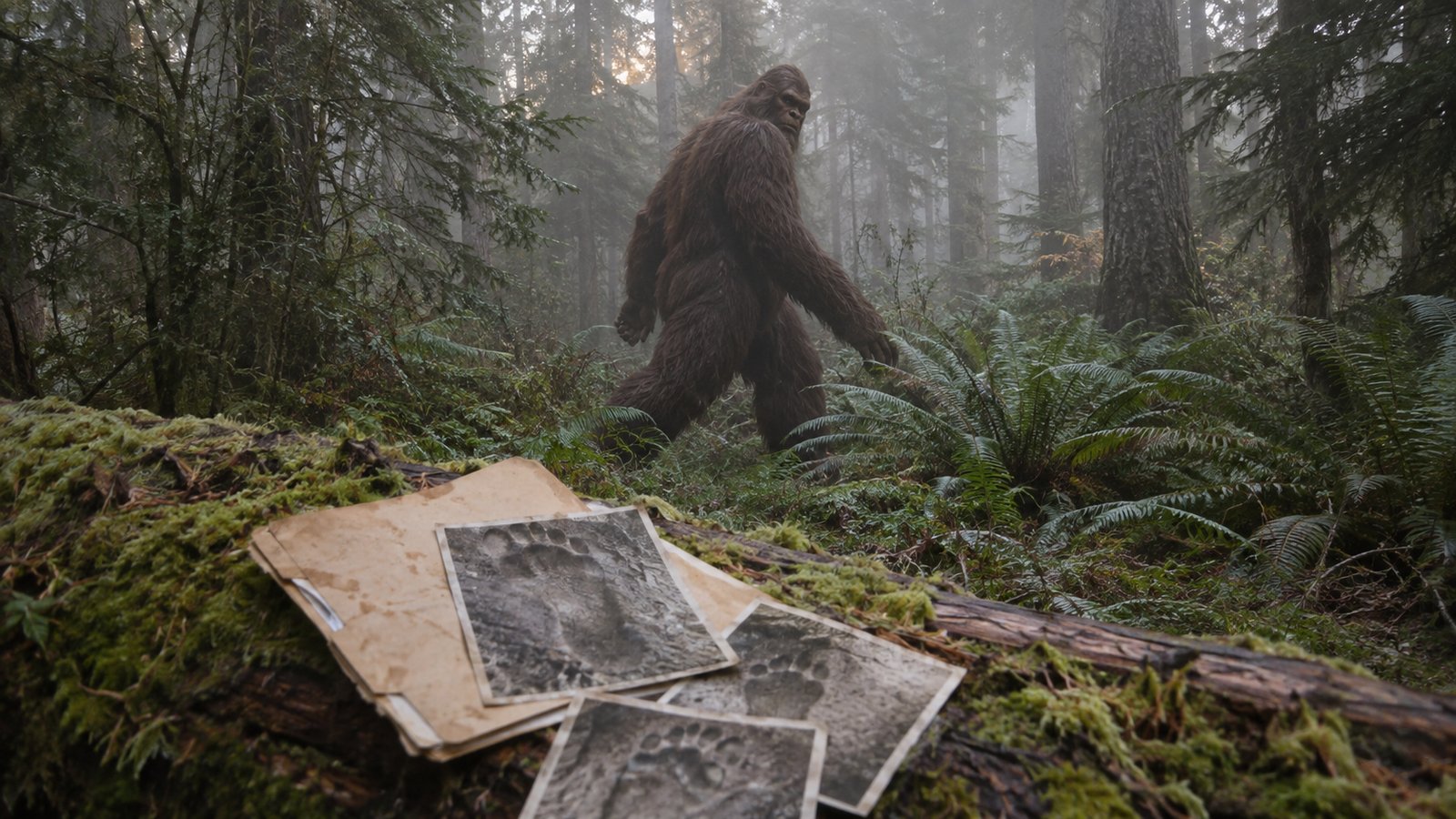
First it was UFOs. Now it's Bigfoot.
With no press release and no briefing, the U.S. Forest Service, part of the Department of Agriculture, posted three files labeled "Bigfoot/Sasquatch Records" to its public records library on Oct. 15. Hardly anyone noticed for a month. This week the internet found them, and the story spread from the Washington Post and New York Post to TMZ.
The files won't end the debate. But they do show that federal employees spent real time on the question, and that at least one government biologist couldn't fully explain what he saw.
The release
Strictly speaking, these weren't "declassified." Bigfoot records were never top secret. But the files come out of the same Trump administration push for transparency that produced the Pentagon's release of UFO files in May. They are posted in the Forest Service's FOIA reading room, where anyone can read them.
There are three files.
File 1: The 1982 tracks that stumped a biologist
The centerpiece is a 1982 Forest Service investigation of giant footprints in the Umatilla National Forest, in the Mill Creek Watershed on the Washington-Oregon line.
- Who investigated: Rodney L. Johnson, a Forest Service wildlife biologist, examined tracks along Low Creek Trail and the nearby ridges.
- What's in the file: Black-and-white photos with crime-scene-style markers and two memos summarizing his findings. One photo shows a single print about 15 inches long and 7 inches wide.
- What he concluded: The tracks "were made by something other than a 300 pound plus two footed being." He listed oddities: the stride didn't change going up or down slope, and forest litter seemed to have been swept aside before the prints were made. He suggested something may have been "rocked back and forth" to press them in.
- But he didn't call them fake. He wrote that if they were faked, "someone went to a great deal of trouble and detail."
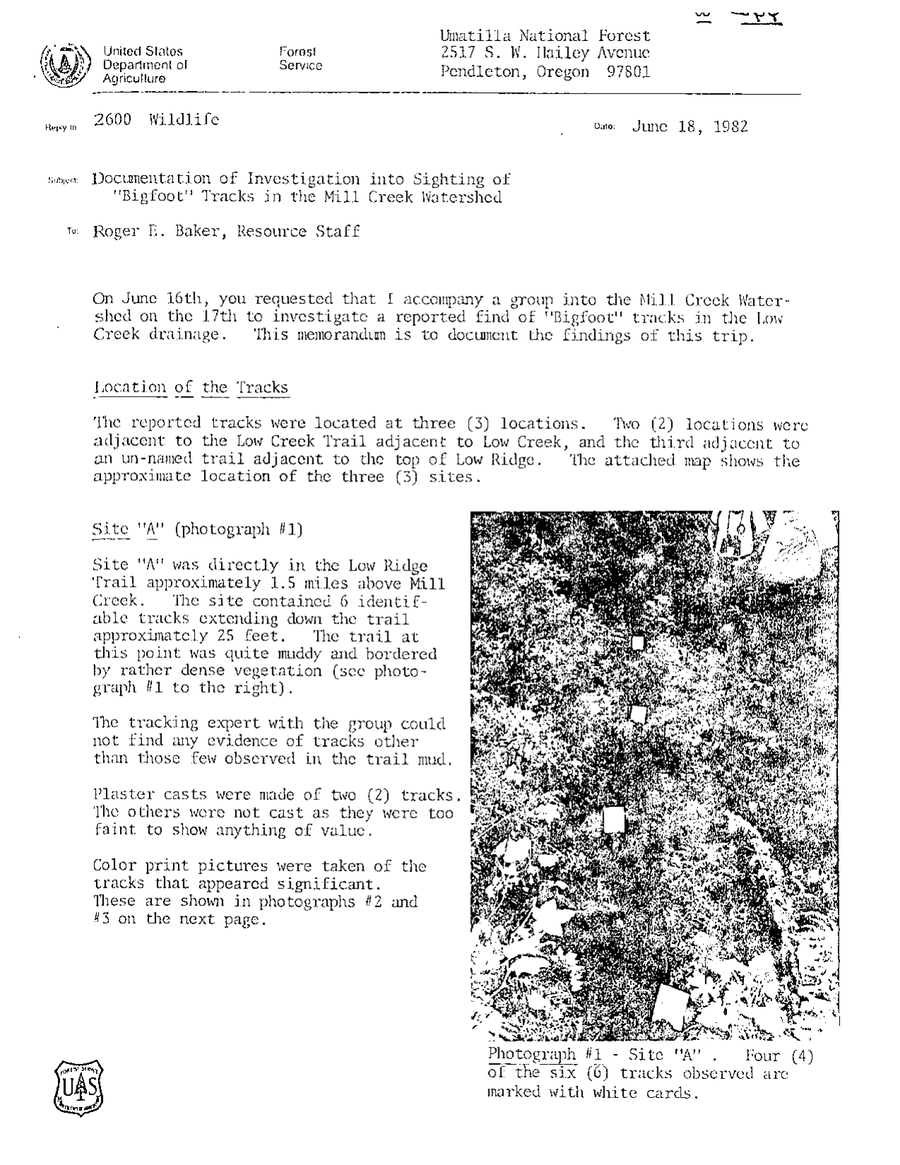
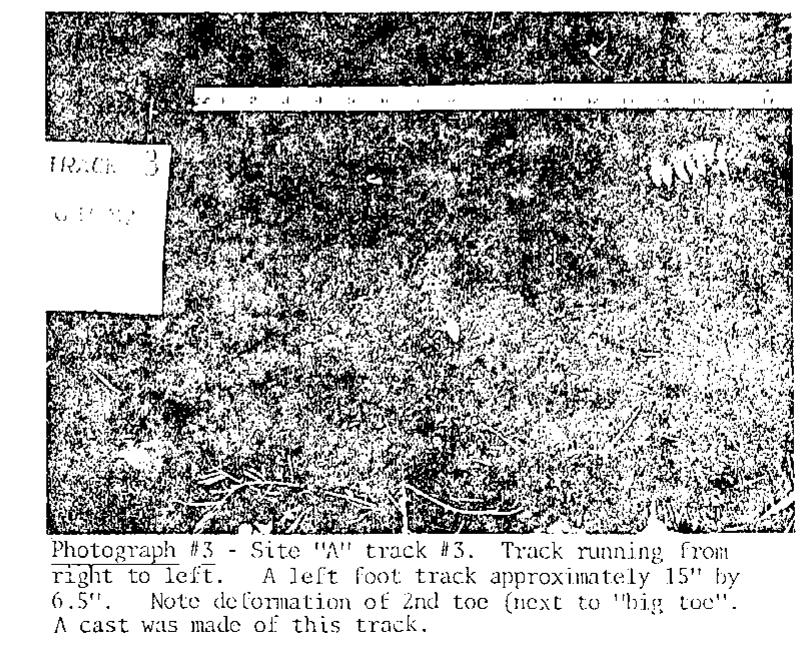
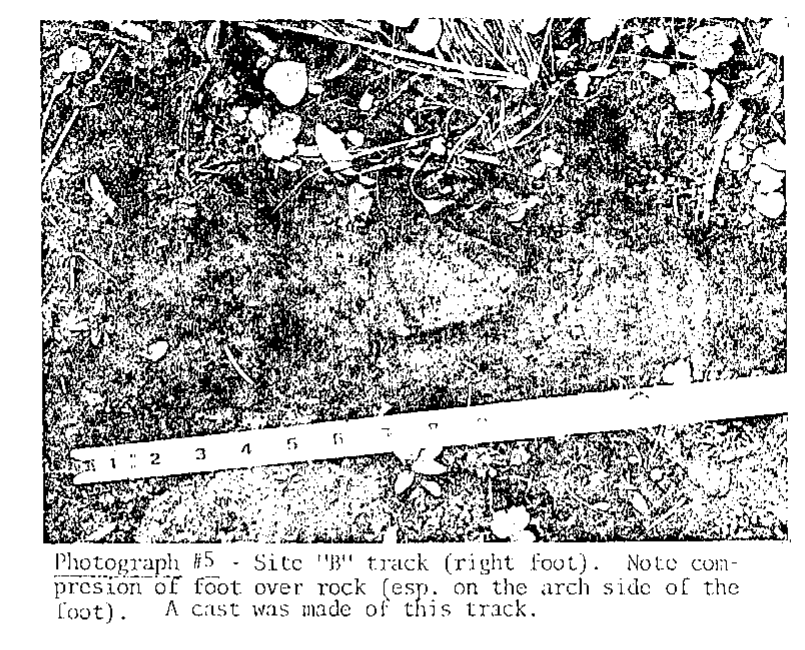
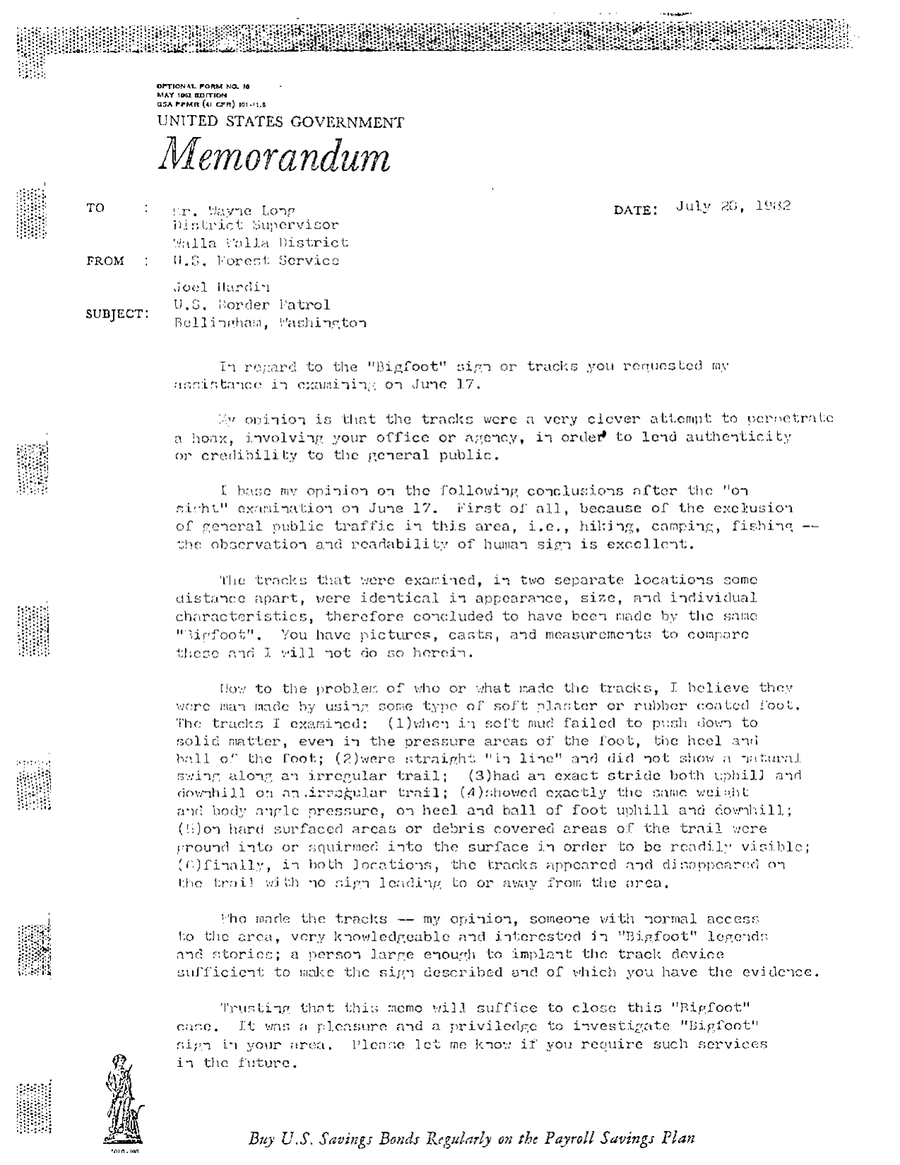
The file also contains a July 26, 1982 memo from Joel Hardin, a U.S. Border Patrol tracker in Bellingham, Washington, to the Forest Service's Walla Walla District. He saw the same tracks and was blunt: they were "a very clever attempt to perpetrate a hoax." He believed someone made them with a fake foot of plaster or rubber. His reasons were that the prints were too straight, kept an exact stride uphill and down, and appeared and disappeared with no trail leading in or out.
That fits the history. One of the file's photos shows the boot of "watershed rider Paul Freeman" next to a track for comparison. These were the famous 1982 Freeman tracks, reported by that Forest Service patrolman, which have divided Bigfoot researchers ever since. Some anthropologists said the casts showed skin-ridge detail too fine to fake. Professional trackers said they were a hoax.
File 2: A hunter's letter, and "we have pictures"
The second file is a 1980 account from Leo T. Kinney, a longtime resident of the Petty Creek and Alberton area of western Montana. He describes encounters with a large, strange animal in 1949 and 1950:
- Huge tracks.
- A strong odor.
- A "grunting type noise."
He and the other hunters decided not to follow it. They later admitted they "could feel chills running up and down our backs."
Near the end of the letter, Kinney asks the government to contact his family, writing, "we have pictures." The files don't show whether anyone ever followed up.
File 3: A boy finds footprints in Montana
The third file is a 2003 newspaper clipping from Montana's Clark Fork Valley Press. It tells the story of 8-year-old Austin Peterson, who found large prints in the woods. A neighbor, Bob Mesing, followed the trail about 100 yards. He estimated a five-foot stride and feet more than 16 inches long. Mesing said he didn't know whether he believed in Bigfoot, but the tracks were there.
What believers are saying
Bigfoot researchers are thrilled, mainly because of what the release might mean next. Many are hoping it's the first of more releases, and some are asking why cryptid files are coming out now at all.
What skeptics are saying
Skeptics point out that the files contain no body, no bones, no DNA and no clear photo. In the main case, the government's own experts were split, and one called it a hoax.
Wildlife agencies haven't budged either. A Colorado Parks and Wildlife spokesman noted this fall that the state manages more than 960 wildlife species, and "bigfoot is still not one of them."
There's also a precedent. In 2019 the FBI released its own Bigfoot file from the 1970s. When the FBI lab tested 15 hairs a researcher sent in, they turned out to come from the deer family.
Why it's catching on now
The timing is good for Bigfoot:
- Sightings: This fall brought a run of reported sightings, including a New Jersey couple who say an 8-foot creature crossed the road in front of their car, a deer hunter near St. Maries, Idaho, who reported tree knocks and "the smell," and a woman who says she saw one along a Colorado mountain highway.
- Pop culture: Bigfoot is having a year: an off-Broadway musical, a new documentary, and a stinky Sasquatch hiding in the woods of the new GTA 6.
The files don't prove Bigfoot is real. What they show is that, for a few decades at least, the federal government took the question seriously enough to send a biologist into the woods with a tape measure.
Read the files yourself: U.S. Forest Service FOIA Reading Room
Sources
- KIRO 7: U.S. Forest Service releases documents from Bigfoot investigations
- Yahoo News: The US government just quietly released official Bigfoot files
- WKRC: Feds quietly release Bigfoot files
- The Post Millennial: Trove of Bigfoot docs released by Trump admin
- TMZ: Trump administration releases files on Bigfoot
- Cowboy State Daily: Bigfoot sightings in the Rockies
- History.com: The FBI's Bigfoot file
Questions readers ask
What is Media Mogul News?
Media Mogul News is an independent, reader-supported news site led by Chief Editor Nate Jurewicz. We cover the stories corporate media skips: political corruption, Big Pharma, the deep state, election integrity, cannabis freedom, crypto and the money behind all of it.
What is your political stance?
We are pro-liberty, pro-cannabis, anti-war and anti-corruption, and we hold both parties to the same standard. We are not a party outlet. When the people we agree with get something wrong, we say so.
How is Media Mogul funded?
By readers. We take no pharmaceutical advertising and no money from the industries we cover. Support comes from newsletter readers, donations and Media Mogul merchandise.