
The Hemp 'Rescue' Bill Saves THC Drinks and Gummies. Flower, Vapes and Delta-8 Don't Make the Cut.
The Hemp Guardrails Act is being sold as the answer to the December 11 hemp ban. We read the bill. It would keep drinks and edibles legal, but smokable flower and most concentrates would be left out, and delta-9 made from CBD could still be sold.

By Nate Jurewicz · Founder & Chief Editor
· 8 min read
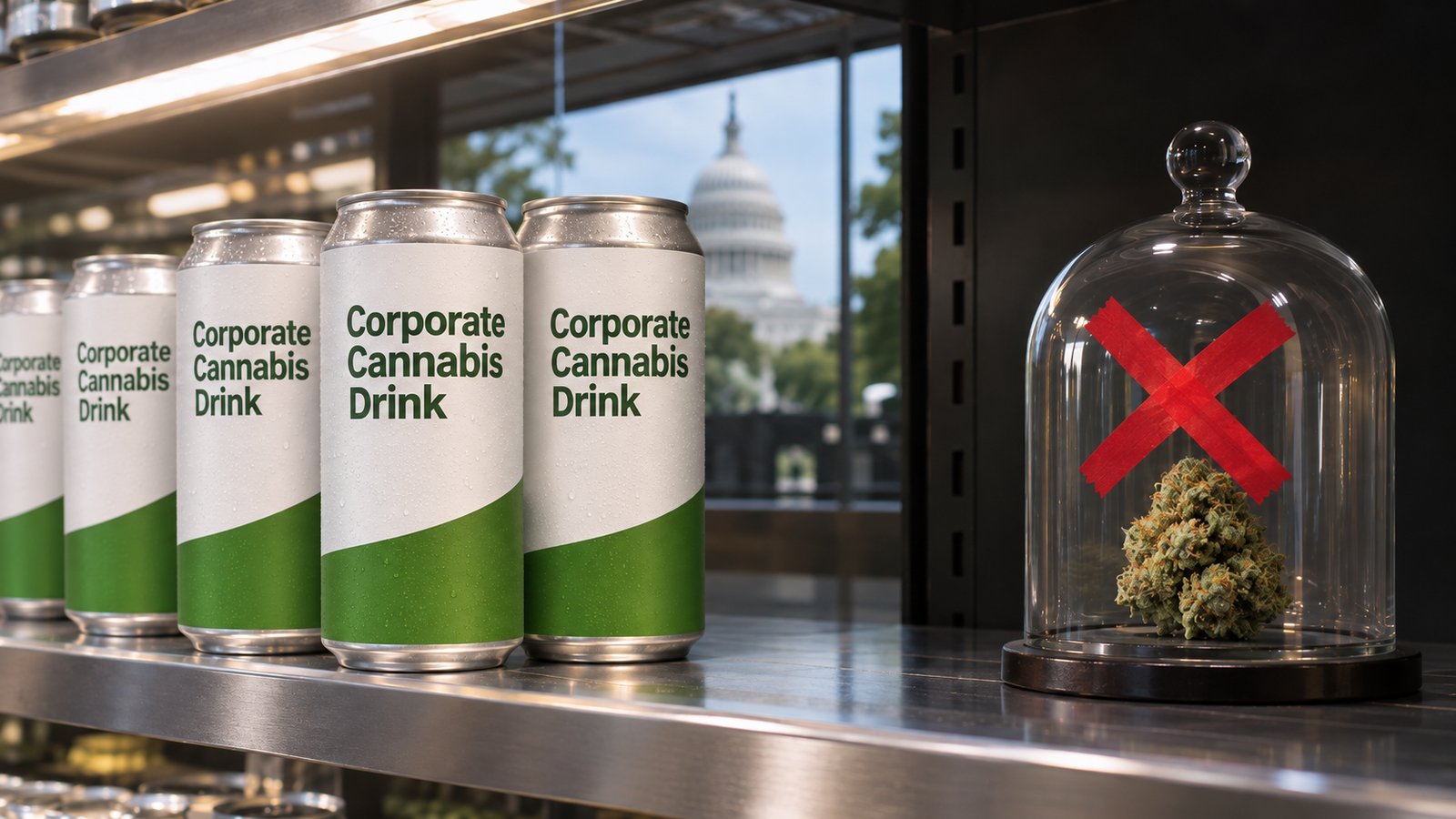
Washington has a new answer to the federal hemp ban, and much of the hemp world is cheering it. Read the fine print, though, and the people who built the industry on smokable flower and concentrates mostly lose.
On November 17, Sens. Tim Sheehy (R-Mont.) and Amy Klobuchar (D-Minn.) introduced the Hemp Guardrails Act, S. 5736. It is meant to replace the rule that takes effect December 11, which caps hemp products at 0.4 milligrams of total THC per container. That cap is low enough to wipe out nearly every THC gummy and drink on the market today.
Sheehy says the bill would "put every bad actor in the hemp space out of business." The U.S. Hemp Roundtable, the industry's biggest lobby, has endorsed it. Charlotte's Web backs it. Several outlets have called it a rescue.
It is a rescue for some products. It isn't one for others. Here is what the 17-page bill actually does, checked against the text posted on GovInfo.
What stays legal
- Drinks, gummies and other edibles. Beverages are listed as an allowed product form. Foods with hemp cannabinoids can be sold if they meet FDA food rules and the bill's new cannabinoid rules.
- CBD and other non-intoxicating cannabinoids. CBD, CBN, CBG, CBC, CBDV and THCV are expressly kept off the restricted list.
- Delta-9 THC. Delta-9 is excluded from the "restricted cannabinoids" definition too.
- Hemp seed foods. Hemp seed, hemp seed oil and hempseed protein without cannabinoids would be treated as ordinary food. The bill does not ban hemp seeds.
The bill also raises the THC limit for hemp from 0.3% to 1% total THC by dry weight, counting THCA. There is no milligram cap per serving or per can.
What gets cut
- Smokable flower and pre-rolls. The bill bars "raw floral hemp material, smokable flower, or pre-roll material" intended for inhalation from interstate commerce. The sponsors call it "gas station weed."
- Delta-8, delta-10, HHC and THC-O. These are named as restricted cannabinoids, along with their isomers, analogs, esters, ethers and salts.
- Most vapes and concentrates, in practice. Concentrates aren't banned by name. But finished products would have to stay at or under 1% total THC. Ingredients may go higher only while they are still being processed between manufacturers, never at retail. A typical vape cartridge or dab runs far above 1%. Jim Higdon, co-founder of Cornbread Hemp, who spent this week in Washington lobbying for the bill, summed it up on X as a bill that would "restrict vapes to 1% total THC."
- Anyone under 21, and any product not grown, processed and packaged in the United States.
That 1% standard is the heart of it. A 12-ounce can weighs about 355 grams, so a drink can carry plenty of THC and still sit far below 1% by weight. A gram of flower or oil can't. The same rule that saves the seltzer shuts out the smoke shop.
The "synthetic" question
The sponsors' press release says the bill "prohibits synthetic cannabinoids which often originate in China." The bill text itself never uses the word "synthetic." It bans a named list of intoxicating compounds and exempts delta-9 THC, without saying how delta-9 has to be made.
That matters, because much of the delta-9 in today's gummies and drinks starts as CBD that is chemically converted in a lab. Marijuana Moment's reading of the bill is that it would keep allowing conversions of CBD, delta-9 and other natural hemp compounds outside the plant, as long as the end product is a compound that occurs naturally. Our reading of the text matches that: nothing in it would stop CBD-derived delta-9 from being sold.
So a converted, lab-made delta-9 gummy would likely stay legal, while a naturally grown hemp flower would not. Critics call that backwards. Supporters say what matters is the final molecule and honest labeling, not where it started.
Testing: required, but not spelled out
Some critics say the bill has no lab-testing requirement. That isn't accurate, but the details are left to regulators. The bill orders the FDA to write "uniform manufacturing and testing requirements," including tests for "potential contaminants" and cannabinoid content, plus third-party lab testing of finished products. Every label would need a QR code or web link to a certificate of analysis.
What the bill doesn't do is list the panel. It doesn't name heavy metals, pesticides, residual solvents or microbes. The FDA would have 180 days after enactment to write those rules. The FDA never wrote rules for CBD in the years after the 2018 Farm Bill legalized hemp, so how strong these rules turn out is a fair question.
Who wins
The products that survive are the ones big companies bet on. Several of the largest marijuana companies have sold hemp-derived THC drinks. Trulieve and Curaleaf launched their own, Green Thumb invested in Agrify, which bought the Señorita drink brand, and Tilray, the nation's fourth-largest craft brewer, sells hemp THC seltzers through its beer distributors. Curaleaf has since said it would exit hemp THC ahead of the ban.
The alcohol business is split. More than 50 beer, wine and spirits distributors, the Beverage Alcohol Merchants Coalition and Total Wine have pushed Congress to keep hemp drinks legal and regulate them like alcohol. The big producers went the other way: the Beer Institute, the Distilled Spirits Council and four other trade groups wrote Congress on November 12 to back the ban.
We found no beverage or alcohol group listed as an endorser in the sponsors' announcement. The groups out front are hemp companies and the Hemp Roundtable. Higdon has served on the Roundtable's board, and Cornbread itself sells THC gummies and seltzers.
Small sellers who built their businesses on flower see it differently. Christian Von James, a hemp business owner who runs WeedCigs.com, told Media Mogul News he doesn't buy the safety argument.
"This has nothing to do with consumer safety as they say," Von James said. "For the past year I've been telling my 200,000 followers to email their congress members my full comprehensive regulation plan. It simply falls on deaf ears because the only thing that influences change is lobby money. And corporations have the most of it."
He then added: "Any politicians who accept money from Kim Rivers, owner of Trulieve, or their subsidiary lobby groups should be heavily scrutinized. This company is primarily responsible for the recriminalization of hemp & cannabis nationwide."
Rivers is Trulieve's CEO and board chair. Trulieve is one of the country's largest marijuana companies and a member of the U.S. Cannabis Roundtable, which lobbied Congress this year to keep the federal hemp ban in place. In August, Trulieve representatives joined the group's meetings with House offices, and in October the Roundtable said the cannabis industry is united in urging Congress to close the "farm bill loophole," which it says has undermined state cannabis programs. Whether Trulieve is "primarily responsible" is Von James's view. Here is what the public records show the company has spent on politics nationwide:
- Federal lobbying: at least $1.4 million since 2024. About $800,000 in Senate lobbying filings through January 2026, then $300,000 in each of the first and second quarters of 2026, the most the company has ever spent.
- Super PACs: $3.7 million in the 2026 cycle, according to FEC records. That includes $2.5 million to America First Agriculture Action in June 2026, $800,000 to the cannabis industry's American Rights and Reform PAC (which gave $1 million to President Trump's MAGA Inc.), $250,000 to the RJC Victory Fund, and smaller checks to Conservative Fighter PAC, Conservatives for American Excellence, Valor Project and Florida's Voice PAC.
- Trump's inauguration: $750,000 to the Trump Vance Inaugural Committee in December 2024 (FEC records via Marijuana Moment).
- Ballot campaigns: about $212 million in Florida, the only state where we found Trulieve funding a ballot measure. That is $144.6 million of the $153.8 million behind 2024's Amendment 3, which failed, plus about $67 million toward a 2026 rerun that never made the ballot.
- Rivers personally has given to federal candidates and committees in both parties, including the National Republican Senatorial Committee, Sen. Ashley Moody, Rep. Randy Fine and House Democratic Leader Hakeem Jeffries, according to FEC records.
Total: at least $217 million in disclosed political spending since 2022. These figures don't include money Trulieve gave to state candidates and party committees. Super PAC totals run through the most recent FEC reports, filed in late August.
The other side
The sponsors and their allies argue that half a loaf beats the alternative. Without a deal, the December 11 rule bans almost everything, flower and drinks alike, and turns what the sponsors call a $30 billion industry into a federal crime overnight. Banning smokable flower, they say, is the price of winning over lawmakers who see THCA flower as marijuana sold under another name.
They may be right that it's the only bill that can pass. Some Republicans won't vote for even this. Sen. Ted Budd (R-N.C.) said he won't support any year-end package that "extends, delays or builds a regulatory framework" for these products. Rep. James Comer (R-Ky.) has said the best path is attaching hemp language to the spending bill due December 11.
That leaves a real choice for the people who use flower, vapes and concentrates. Many of them are veterans and patients who live in states without legal marijuana. They can back a bill that keeps the drinks and gummies, or hold out for one that covers the whole plant before the clock runs out.
What to do
The bill is in the Senate Health, Education, Labor and Pensions Committee. It has no hearing scheduled. If you have a view, call your senators at the Capitol switchboard, (202) 224-3121, before December 11.
Media Mogul News will update this story as the bill moves.
Sources
- Bill text, S. 5736 (Hemp Guardrails Act), GovInfo: https://www.govinfo.gov/app/details/BILLS-119s5736is
- Sen. Tim Sheehy press release, Nov. 17, 2026: https://www.sheehy.senate.gov/news/press-releases/sheehy-klobuchar-introduce-bipartisan-hemp-guardrails-act/
- Sen. Amy Klobuchar press release: https://www.klobuchar.senate.gov/public/index.cfm/news-releases?ID=E8408D0B-2569-4329-BF57-EA81857C6151
- Marijuana Moment: https://www.marijuanamoment.net/bipartisan-senators-file-bill-to-keep-hemp-thc-products-federally-legal-as-next-months-scheduled-ban-looms/
- Marijuana Moment, GOP senators vow to block hemp language: https://www.marijuanamoment.net/gop-senators-say-theyll-try-to-block-any-government-funding-bill-that-keeps-hemp-thc-products-legal/
- Cannabis Business Times: https://www.cannabisbusinesstimes.com/hemp/news/16541927/us-senators-finalize-plan-to-rescue-hemp-products-from-ban
- Lexology analysis: https://www.lexology.com/library/detail.aspx?g=03f61a3f-2634-4cc1-8749-80ee69d78ddd
- Charlotte's Web statement: https://www.stocktitan.net/news/CWBHF/charlotte-s-web-backs-bipartisan-plan-for-a-responsible-federal-hemp-q3pnercc4pf2.html
- MPR News: https://mprnews.org/story/2026/11/19/federal-hemp-thc-ban-could-be-stopped-by-new-bill-in-senate
- Jim Higdon on X: https://x.com/jimhigdon/status/2123881398931161508
- Alcohol groups' letters: https://www.marijuanamoment.net/alcohol-manufacturers-pushing-congress-to-ban-hemp-products-live-in-their-own-anti-thc-echo-chamber-op-ed/ and https://mjbizdaily.com/?p=407853
- Marijuana companies' hemp drinks: https://www.itiger.com/news/2514862485, https://mjbizdaily.com/?p=408482, https://www.bnnbloomberg.ca/investing/cannabis/2025/07/23/big-alcohol-prepares-to-fight-back-as-buzzy-cannabis-drinks-steal-sales/
- FEC contributions by Trulieve (super PACs): https://www.fec.gov/data/receipts/?contributor_name=trulieve
- FEC contributions by Kim Rivers: https://www.fec.gov/data/receipts/individual-contributions/?contributor_name=rivers%2C+kim&contributor_state=FL
- Trump inaugural donation: https://www.marijuanamoment.net/marijuana-companies-donated-at-least-1-million-to-trumps-inauguration-new-federal-records-show
- Trulieve lobbying: Bloomberg Government https://news.bgov.com/bloomberg-government-news/cannabis-companies-up-lobbying-on-cusp-of-marijuana-policy-shift, Legis1 https://legis1.com/news/cannabis-lobbying-spending-trulieve-corp-spends, Integrity Index https://integrityindex.us/company/TRLV
- U.S. Cannabis Roundtable and the hemp ban, Cannabis Business Times: https://www.cannabisbusinesstimes.com/hemp/news/15837312/cannabis-advocacy-group-lobbies-congress-to-avoid-blanket-ban-on-hemp-thc-products
- Florida ballot spending: WRD/Who Funds Marijuana Legalization https://wrdnews.org/marijuana-industry-funding-who-pays-and-who-profits-from-it/, Cannabis Business Times https://www.cannabisbusinesstimes.com/us-states/florida/news/15836634/florida-may-have-3-options-to-legalize-adultuse-cannabis-in-2028, CBS Miami https://www.cbsnews.com/miami/news/new-florida-recreational-marijuana-proposal-emerges-amendment-3/
- MAGA Inc. donation from American Rights and Reform PAC: https://mjbizdaily.com/?p=406207
- Cornbread Hemp products: https://spectrumnews1.com/ky/louisville/news/2025/11/21/cornbread-hemp-lobbies-lawmakers
Questions readers ask
What is Media Mogul News?
Media Mogul News is an independent, reader-supported news site led by Chief Editor Nate Jurewicz. We cover the stories corporate media skips: political corruption, Big Pharma, the deep state, election integrity, cannabis freedom, crypto and the money behind all of it.
What is your political stance?
We are pro-liberty, pro-cannabis, anti-war and anti-corruption, and we hold both parties to the same standard. We are not a party outlet. When the people we agree with get something wrong, we say so.
How is Media Mogul funded?
By readers. We take no pharmaceutical advertising and no money from the industries we cover. Support comes from newsletter readers, donations and Media Mogul merchandise.